
A little humour: the illustration is metaphorical, not an actual flood.
A friend once told me, “There is no such thing as a crisis without an opportunity.” This week, a small and rather frustrating experience reminded me why that idea matters.
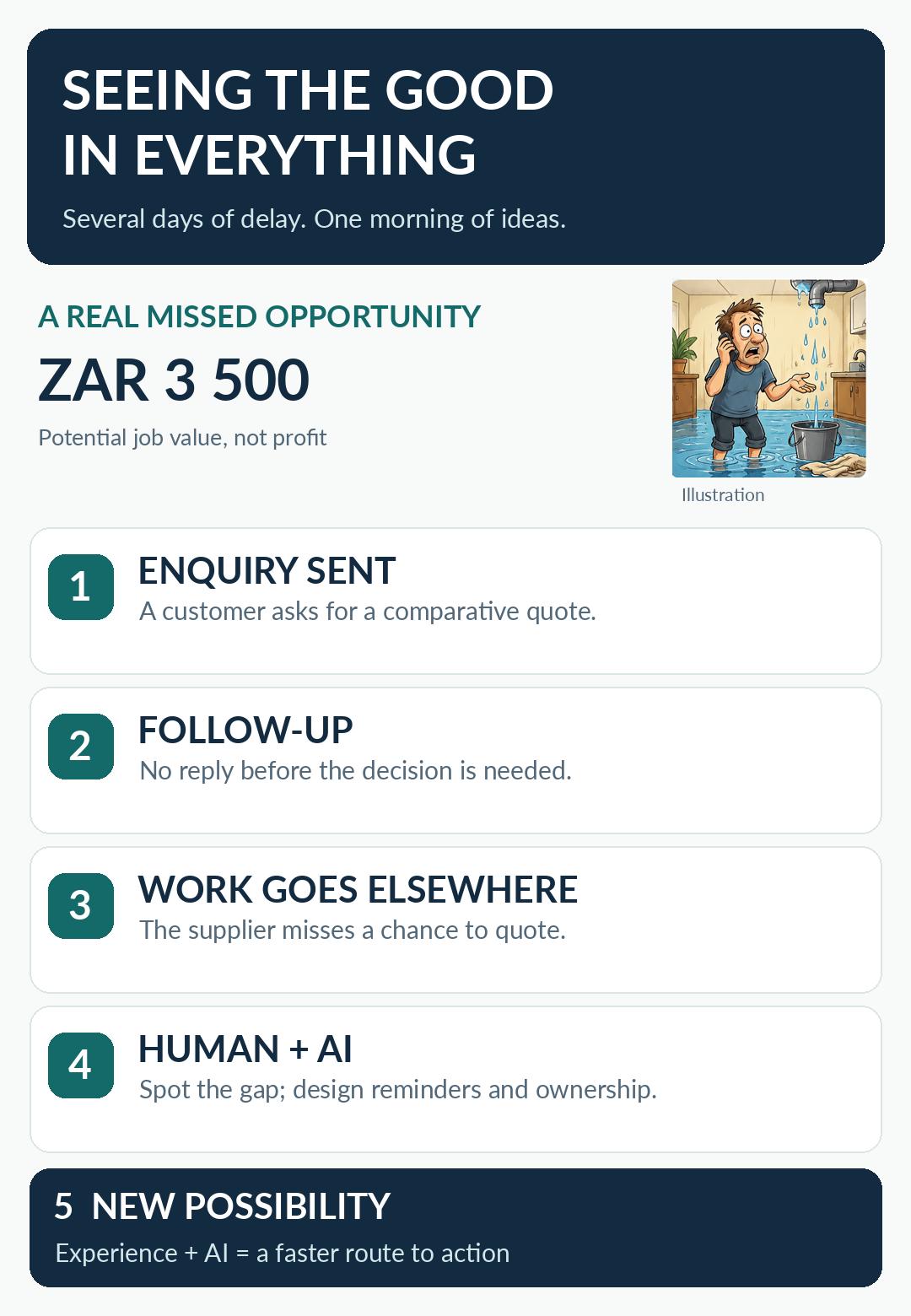
On 26 October, I emailed a South African service business, asking it to review some proposed work and provide a comparative quotation. I followed up on 30 October. When I needed to make the decision, I had not received a reply, so I appointed another provider.
The job was worth approximately ZAR 3 500. That is the potential value of the work the business missed an opportunity to quote for, not evidence it would have won the work or earned that amount in profit.
The striking part wasn't the price. It was the missing communication. Even a quick “Thanks, we've received your enquiry; we'll respond by Tuesday” could have kept the conversation open.
A problem that developed over days
I don't know what happened inside the business. The email could have been overlooked, the team could have been busy, or another contact channel might have worked better. I can only describe my experience: an enquiry, a follow-up, and no reply before I made my decision.
Five days after the original enquiry, I had already moved on. That is a commercial risk for any business that depends on incoming enquiries.
I already had an existing relationship with this supplier. Because of that relationship, I might contact them again despite this experience. If this had been my first contact, however, the poor response might discourage me from reaching out again in future.
Then came the much faster part
On Saturday morning, a WhatsApp message prompted me to revisit the situation. I spotted a second opportunity: instead of simply complaining, I could use the example to demonstrate how a better enquiry process might protect future work.
I brought my project-management and commercial judgement to the problem, then used AI to organise the facts, structure the case, draft clear messages, and create a visual journey map. Within the same morning, the experience had become a practical workflow proposal and a draft case study.
I haven't measured the time from the original WhatsApp notification to publication. What I can demonstrate is how quickly human insight and AI-assisted production turned a frustrating experience into useful material.
The solution doesn't need to be complicated
New enquiry → automatic acknowledgement → named owner → reminder if unanswered → quotation, question or polite decline.
For a small service business, that might start with one shared inbox, a response target and a reminder. A more advanced workflow could join up WhatsApp, email and web enquiries, and use AI to flag messages that need attention. A person would still own the decisions.
The principle is simple: make it harder for a potential customer to fall through the cracks.
What changed for me?
I started as someone intending to spend money. I ended up recognising a problem I might be able to help a business solve. I haven't won a new client and I'm not presenting a proposed improvement as an implemented result. But I have a useful case study and a reason to start a constructive conversation.
That's what I mean by Oliver + AI. I bring the experience to identify the business problem and the marketing opportunity, then use AI to accelerate the research, planning, communication and visual storytelling. AI is a tool, not the consultant.
Could this help your business?
I'm South African, now based in the UK. My work through AI PM Workflow is delivered remotely, and I can quote South African customers in rand at rates appropriate to the local market. Remote support doesn't have to mean UK consultancy pricing.
Sometimes the most valuable improvement is not a complex app. It's making sure that every customer gets a prompt acknowledgement, a clear next step and a real chance to do business with you.
If you'd like to explore how a small change could improve your enquiry handling, you're welcome to book a short, no-pressure conversation.
Explore AI PM Workflow
Book a meeting with Oliver
This is an anonymised account of a real enquiry. The flooding cartoon is a metaphor, not a real flood. The workflow described is a proposal, not a deployed system.