
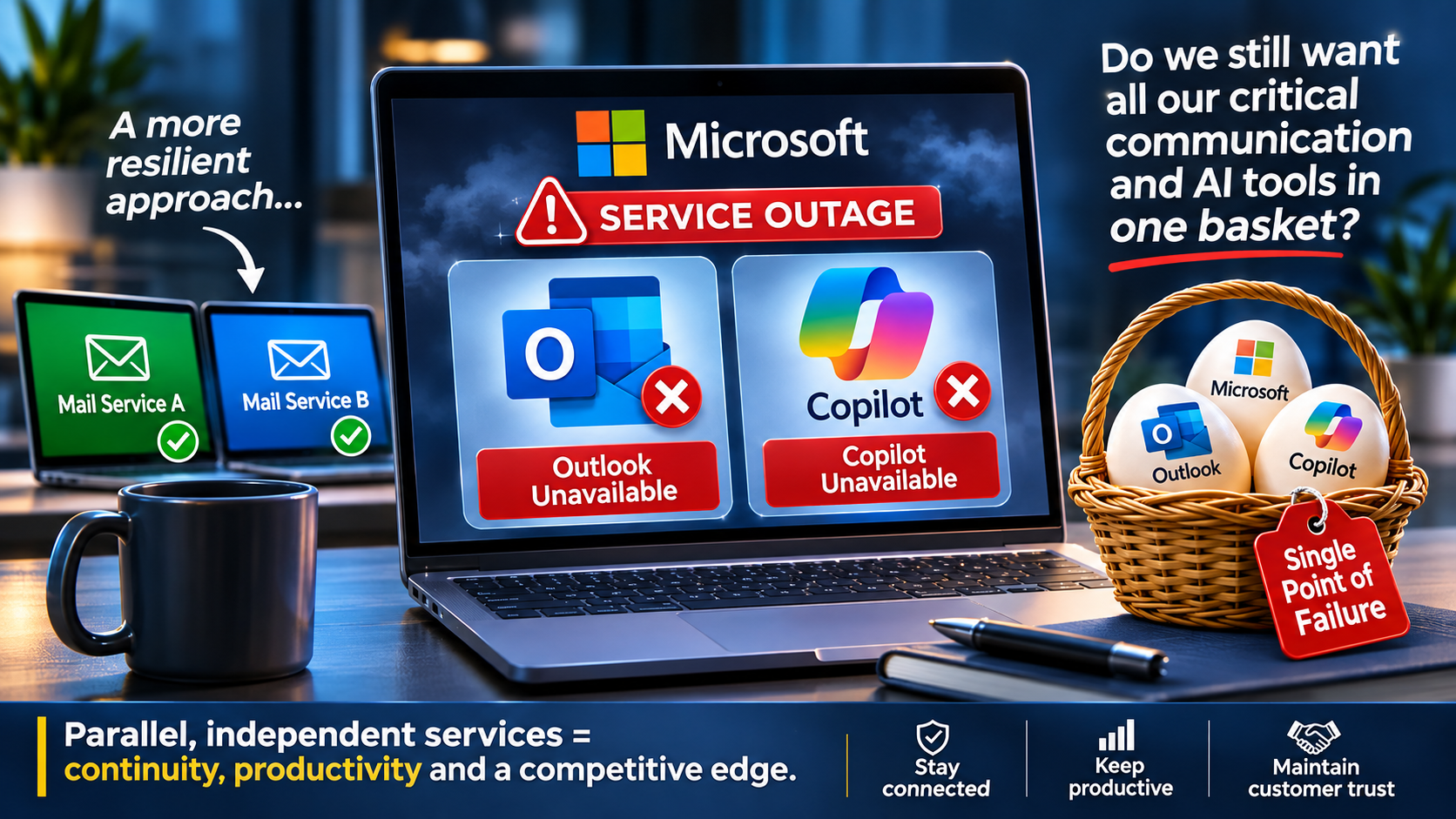
While organisations around the world scramble to deal with the Microsoft 365 disruption, affecting Outlook, Copilot and other services, I've been trying to separate the noise and focus on what really matters.
Are we dealing with this all wrong?
We spend enormous amounts of time and money making businesses more efficient, connecting systems and consolidating services.
But have we inadvertently created a situation where too many critical operations depend on the same technology ecosystem?
And if that ecosystem fails, what happens to our ability to communicate?
The real question isn't why Microsoft went down
Technology fails. Even the biggest providers experience outages.
That's not necessarily the problem.
The problem is how dependent we've become on them.
If your email stops working, that's disruptive enough. If your AI assistant and other productivity tools are also affected, the consequences can quickly spread across your organisation.
When communication is critical, can we really afford to rely on a single point of failure?
Perhaps it's time we stopped asking how quickly our providers can restore service and started asking how we can remain operational when they can't.
What if we didn't put all our eggs in one basket?
Izzy, my AI assistant, and I have started exploring a different approach.
The concept is relatively simple.
What if we could operate two genuinely independent email services in parallel?
Imagine having two communication environments available on your computer.
One provider experiences a major outage.
Instead of scrambling to contact customers, posting service announcements or asking people to telephone you, you simply switch to your alternative environment.
Close the window on the left. Open the one on the right.
And carry on working.
That's the experience we're aiming for.
Of course, there's a catch
Making something appear simple to the end user often requires considerable work behind the scenes.
Two email accounts don't automatically provide business continuity.
We need to consider independent infrastructure, email routing, domain configuration, authentication, synchronisation, security and the ability to receive and send messages reliably during a failure.
We also need to understand which supporting services might still introduce common dependencies.
And with AI tools becoming increasingly integrated into everyday workflows, we should be asking similar questions about their availability and resilience.
The objective isn't simply to have two systems. It's to eliminate avoidable single points of failure without introducing unnecessary complexity.
We're working on the concept
Izzy and I have already begun exploring the architecture and the practical implementation steps.
Our ambition is to make the transition between independent services as straightforward as possible.
Not a complicated disaster recovery exercise requiring specialist intervention.
Just a practical, well-engineered way of staying operational.
To be clear, we're at the concept and development stage. The architecture, technical feasibility and failover arrangements still need to be validated.
But that's precisely why we're asking these questions now.
Resilience is a competitive advantage
Think about two businesses operating in the same market.
Both depend on digital communication.
A major service provider experiences an outage.
One business becomes unreachable, apologises to its customers and waits for services to return.
The other continues communicating and delivering.
Which business would you rather work with?
Business continuity isn't simply about protecting against inconvenience.
It's about reliability, customer confidence and maintaining the ability to deliver when competitors cannot.
And that can be a genuine competitive advantage.
Perhaps it's time to rethink the basket
I'm not suggesting that Microsoft, or any other major provider, is inherently unreliable.
I'm suggesting that we need to challenge our assumptions about dependency.
Centralisation delivers efficiency.
But efficiency without resilience can leave us exposed.
Maybe the question isn't whether we can afford to build redundancy into critical communication systems.
Maybe it's whether we can afford not to.
Let's start a conversation
Izzy and I are continuing to develop the concept and its practical implementation plan as part of our work at AIPM Workflow.
I'd welcome perspectives from business owners, IT professionals, project managers and anyone responsible for keeping critical operations running.
Are we over-reliant on individual technology ecosystems?
And could independent, parallel communication services offer a more practical way forward?
If you'd like to explore this further, please get in touch.
Oliver Marnitz
AIPM Workflow
Keeping Focused on What Matters
#BusinessContinuity #OperationalResilience #Microsoft365 #Copilot #RiskManagement #AIPMWorkflow